
Skin Cancer of the Foot and Ankle.
Expert Diagnosis and Treatment in Bradenton, Lakewood Ranch, & Sarasota
As residents of the great Sunshine State, we are more prone to developing cancers of the skin. While many of us do not think about skin cancer on our lower extremities, it is certainly a problem we encounter infrequently. Florida Foot and Ankle Specialists are dedicated to providing the best foot and ankle care available.
Our board-certified podiatrist, Dr. Jason Spector, has completed additional fellowship training in diagnosing and treating a wide range of foot, ankle, and lower leg disorders. Whether it’s routine preventive care or complex reconstructive surgery, we employ the most advanced treatments to ensure our patients get the desired results.
Our commitment is always to put your health first while providing individualized and compassionate care. We strive to create an atmosphere that is attentive to your needs so that you can get back on your feet again as quickly as possible with excellent standards of quality care. If you have any questions or concerns regarding your foot or ankle condition, don’t hesitate to contact us – we’re here for you!
Types of Foot and Ankle Skin Cancer
Skin cancer is the abnormal growth of skin cells. It most commonly develops in areas that are exposed to the sun, but can also occur in other areas that are not typically exposed such as the feet and ankles.
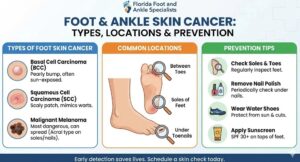
Skin cancer is not “one size fits all.” There are three primary types that affect the feet, each presenting differently:
1.Basal Cell Carcinoma (BCC)
This is the most common form of skin cancer in the U.S. On the feet, it is often caused by chronic UV exposure.
What to look for: A pearly white bump, or a patch of skin that oozes and crusts but never fully heals. It is rarely fatal but can cause local tissue damage if ignored.
2Squamous Cell Carcinoma (SCC)
SCC is the most common type of skin cancer found specifically on the foot.
What to look for: A small, scaly bump or a red, inflamed patch. It often resembles a plantar wart or a fungal infection that just won’t go away. It is mostly confined to the skin but can spread if left untreated.
3Malignant Melanoma
This is the most dangerous form of skin cancer. Melanoma can spread (metastasize) to other parts of the body through the lymphatic system and blood vessels.
Acral Lentiginous Melanoma: This is a specific, aggressive type of melanoma found on the palms of hands, soles of feet, and under nails. It is not related to sun exposure and is the most common subtype of melanoma in people with darker skin tones.
Signs of Skin Cancer Affecting Foot and Ankle
Skin cancer of the foot and ankle can present itself in various forms such as nodules, ulcers, or discoloration of the skin. The signs and symptoms of skin cancer on the foot or ankle may include a discolored area of skin that does not heal, an open sore that bleeds, oozes, or crusts, a shiny bump or nodule on the skin, a scar-like area that is white, yellow, or waxy. If you notice any of these symptoms, please do not hesitate to schedule an appointment with one of our specialists for further evaluation. Early detection is critical in preventing the spread of cancer and increasing treatment success rates.
Causes
Skin cancer can be caused by exposure to ultraviolet (UV) radiation from the sun or tanning beds. It may also be linked to certain genetic factors and medical conditions. People with fair skin, light-colored eyes, and a history of sunburns are at a higher risk of developing skin cancer.
The “ABCDE” Rule: When to Call a Doctor
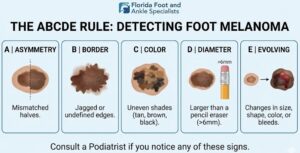
If you have a mole or spot on your foot, use the ABCDE guide to determine if it requires a biopsy.
A – Asymmetry: If you draw a line through the middle, the two halves do not match.
B – Border: The edges are jagged, scalloped, or undefined.
C – Color: The color is uneven (shades of black, brown, and tan) or changes color.
D – Diameter: The spot is larger than a pencil eraser (6mm), though some melanomas can be smaller.
E – Evolving: The spot changes in size, shape, or color, or begins to bleed or itch.
Diagnosis: The Biopsy Process
If Dr. Spector identifies a suspicious lesion during your exam, we will perform a skin biopsy. This is a simple, in-office procedure where a small sample of the skin is removed and sent to a dermatopathologist for analysis.
Punch Biopsy: A circular tool removes a small core of skin to check the depth of the lesion.
Shave Biopsy: The top layer of the lesion is shaved off for testing.
Most biopsy sites heal quickly with standard wound care.
Treatment Options
Once a diagnosis is confirmed, our team will create a personalized treatment plan based on the type and stage of the cancer.
Surgical Excision: The primary treatment for most foot skin cancers. The lesion is removed along with a “safety margin” of healthy skin to ensure all cancer cells are gone.
Mohs Surgery Referral: For complex cases or cancers in difficult areas (like the toes), we coordinate with specialized Mohs surgeons to preserve as much healthy tissue as possible.
Wound Care: For advanced cases requiring larger removal, our
Wound Care
Prevention Tips for Your Feet
Check Your Soles:Inspect the bottoms of your feet and between your toes monthly.
Remove Polish:Check for dark streaks under the toenail (Hutchinson’s sign) often mistaken for fungus.
Water Shoes:Wear water shoes to protect against both UV rays.
Sunscreen:Don’t forget the tops of your feet when applying SPF 30+ at the beach or pool.
Schedule a Skin Check Today
Don’t wait for a “weird spot” to become a painful problem. If you notice a changing mole, a new lesion, or a sore that won’t heal, contact Florida Foot and Ankle Specialists.
Call 941-241-5333 or
This site does not contain or provide medical/health advice. The medical/health information is provided for general information and educational purposes only and is not a substitute for professional advice. Accordingly, before taking any actions based upon such information, we encourage you to consult with the appropriate professionals. The use or reliance of any information contained on this site is solely at your own risk.